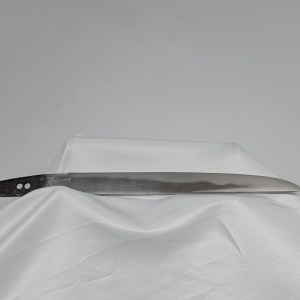
Description
Following the Uda School’s adaptations in the Muromachi Period, various founding lineages continued operating in the school, acting as a bulwark throughout the shifting political situations both inside and outside of Etchu Province, the ignition of various civil wars, and the rise in practical needs for weapons as arms rather than masterpieces. Among these branches is the Kunimune branch, of which a later generation’s katana will be analyzed. Looking directly at the sword’s dimensions, the blade still maintains a somewhat classical style, noted by the great length and thinner frame of the sword, forming a gentle shape similar to Kamakura Period works. Most notable, however, is the great curvature of the sword, which rivals even many of the earliest tachi, making the blade profile particularly unique for a work of the 15th and 16th centuries. Looking at the metallurgy of the blade, the jigane is composed of a coarse itame with spots of o-mokume hada interspersed throughout. Ji-nie shines throughout the steel, alongside small patches of chikei, alluding to the Soshu School inspirations from the practice’s founding stock. Looking into the cutting edge, the temper is composed of a ko-gunome-midare in ko-nie-deki. Nioi is interspersed throughout the hamon, resulting in a misty appearance, although nie-based hataraki are able to be found near the habuchi. Of these, ko-ashi, nie-hotsure, and sunagashi are most prevalent, forming a frayed appearance that continues up into the kissaki. Past the yokote, the fraying subsides, with the hamon tapering into a ko-maru style boshi which terminates upward into a sharp, but short kaeri. With the aesthetic features of the blade discussed, relevant measurements will be listed below.
Measurements:
Nagasa: 75.7 cm (Particularly long for a work of the later Muromachi Period)
Sori: 3.0 cm (Especially deep for any blade of any period, let alone “Sue-Koto” works)
Motohaba: to be measured
Sakihaba:to be measured
Motokasane:to be measured
Sakikasane:to be measured
The nakago of the blade is ubu with a kuri-jiri tip. Along the katana-omote, the yoji-mei signature “Uda Kunimune” (宇多国宗) is finely chiseled into the tang. A single mekugi-ana is punched into the nakago, implying a totally unaltered state despite shifting mountings and wartime needs.
The blade’s shape is in shinogi-zukuri with an iori-mune. This was the most common shape observed in Japanese swords, originating from the late Heian Period and continuing use up into the present day. Despite the commonality of this style, the grand curvature observed is intriguing, as such works are particularly rare for the manufacturing period of this sword. Looking to the surface of the sword, elaborate horimono carvings and fullers have been avoided, likely due to wartime constraints during the late Muromachi Period.
The blade is rated “Hozon” by the NBTHK, confirming a baseline degree of quality for any Japanese sword. The receipt of this rating also confirms the signature chiseled on the tang to be genuine to the original swordsmith. Although the lowest rating from the NBTHK, a greater designation can be received with successive appraisal at NBTHK shinsa.
After Norishige left Kamakura in the Nanbokucho Period, he returned to his native Etchu Province, where he took up swordsmithing once more. There, he came into contact with a fledgling swordsmith who migrated out of Yamato Province in hopes of founding a swordsmithing school, Ko-Nyudo Kunimitsu. The relationship between these two smiths is unclear, but what is known is that Norishige took in the sons of Kunimitsu, those being Shodai Kunifusa and Kunimune, training them in his distinct brand of the Soshu School’s techniques. Together, these two swordsmiths would found the Ko-Uda School, joining both the Fujishima School and Chiyozuru School as the distinctive side-schools of Etchu Province. Of the two founders, Kunimune was considered the finer swordsmith, inheriting more of Norishige’s distinctive style than his brother, often leading to comparisons between the master and student, with the Yamato-inspired sugata and hamon often being used to distinguish between the two. Shodai Kunimune, like his brother, operated from 1361 CE to approximately 1394 CE, defining the unique Ko-Uda style through the coalescence of Norishige and the Soshu School’s unique grain work alongside the classic charm of Yamato’s more subdued proportions and temper, all while including select features possibly inspired by their local competitors. As the Nanbokucho Period came to an end, multiple generations of Kunifusa- and Kunimune-named swordsmiths continued the tradition, albeit never to the same level as Shodai Kunimune. The workmanship and signature style of this work establish the katana as a work of the later Kunimune smiths, specifically operating from the late Muromachi Period. Of this lineage, two generations fall within this timeframe, those being the third-generation Kunimune, who operated from 1429 CE to 1469 CE, and the fourth-generation Kunimune, who operated from 1492 CE through 1537 CE. Of these two, the fourth-generation is more likely, primarily through the meshing of the Bizen tradition, as is noted with the greater presence of nioi in the hamon of this blade. This Bizen-directed shift slowly sacrificed the identity of later Uda blades, and a concurrent loss of regional specialization eventually led to the decline of the school in the early Edo Period. As such, the example above is a truly interesting piece, displaying a later iteration of Uda work that does not fully sacrifice the blade’s provincial charms. Furthermore, the length of this blade allows for a greater degree of appreciation, not only due to the scarcity of longer works of the Muromachi Period, but also due to the incredible curvature observed throughout the blade.
~Photographs from Charlie White’s Facebook page; Blade in Possession of Charlie White, description by Nicholas Zogu~